

Mathematical Logic Questions With Answers Pdf
The proposition (P ⇒ Q) ∧ (Q ⇒ P) is a
- tautology
- contradiction
- contingency
- absurdity
Answer (Detailed Solution Below)
Option 3 : contingency
Concept:
- A compound proposition that is always true for all possible truth values of the propositions is called a tautology.
- A compound proposition that is always false is called a contradiction.
- A proposition that is neither a tautology nor contradiction is called a contingency.
Formula:
a ⇒ b = ¬ a ∨ b
Calculation
(P ⇒ Q) ∧ (Q ⇒ P)
( ¬ P ∨ Q) ∧ ( ¬ Q ∨ P)
replace ¬ with NOT ( ̅ ), ∨ with OR (+) and ∧ with AND (.)
(P̅ + Q).(Q̅ + P)
P̅.Q̅ + P̅.P + Q.Q̅ + QP
P̅.Q̅ + QP
P ⊙ Q
Truth Table:
| Input P | Input Q | Output Y = P⊙ Q |
| 0 | 0 | 1 |
| 0 | 1 | 0 |
| 1 | 0 | 0 |
| 1 | 1 | 1 |
The proposition (P ⇒ Q) ∧ (Q ⇒ P) is a contingency
Tips and tricks
(P ⇒ Q) ∧ (Q ⇒ P) = P⇔ Q (It is always contingency)
The statement (¬ p) ⇒ (¬ q) is logically equivalent to which of the statements below?
- p ⇒ q
- q ⇒ p
- (¬q) ∨ p
- (¬p) ∨ q
- I only
- II and IV only
- II only
- II and III only
Answer (Detailed Solution Below)
Option 4 : II and III only
Formula:
p ⇒ q ≡ ¬ p ∨ q
Derivation:
(¬ p) ⇒ (¬ q)
≡ ¬ (¬ p) ∨ (¬ q)
≡ p ∨ (¬ q)
Statement I,
p ⇒ q
≡ (¬ p) ∨ q,
Statement II,
q ⇒ p
≡ (¬ q) ∨ p
≡ p ∨ (¬ q)
Statement III,
(¬q) ∨ p
≡ p ∨ (¬ q)
Statement IV,
(¬p) ∨ q
Only II and III option matches with the given implication.
Alternate Method:
By using Truth table:
| P | q | ¬ p | ¬ q | (¬ p) ⇒ (¬ q) | p ⇒ q | q ⇒ p | (¬q) ∨ p | (¬p) ∨ q |
| True | True | False | False | True | True | True | True | True |
| True | False | False | True | True | False | True | True | False |
| False | True | True | False | False | True | False | False | True |
| False | False | True | True | True | True | True | True | True |
So, only II and III matches with the given implication.
Let p, q, r, s represents the following propositions.
p: x ∈ {8, 9, 10, 11, 12}
q: x is a composite number
r: x is a perfect square
s: x is a prime number
The integer x ≥ 2 which satisfies ¬ ((p ⇒ q) ∧ (¬ r ∨ ¬ s)) is __________
Answer (Detailed Solution Below) 11
Data:
p: x ∈ {8, 9, 10, 11, 12}
q: x is a composite number
r: x is a perfect square
s: x is a prime number
Explanation:
p ⇒ q means p̅ + q
As, q is composite number So, p ⇒ results in {8, 9, 10, 12}
As, r: x is a perfect square, ¬ r results in all the numbers which are not perfect square
So, ¬ r: {8, 10, 11, 12}
¬ s: {8, 9, 10, 12}
¬ r ∨ ¬ s = {8, 9, 10, 11, 12}
Now, (p ⇒ q) ∧ (¬ r ∨ ¬ s) = {8, 9, 10, 12}
¬ ((p ⇒ q) ∧ (¬ r ∨ ¬ s)) results in a number which is not present in ((p ⇒ q) ∧ (¬ r ∨ ¬ s))
¬ ((p ⇒ q) ∧ (¬ r ∨ ¬s)) will give {11}.

The ratio of the area of the inscribed circle to the area of the circumscribed circle of an equilateral triangle is _____
- \(\frac{1}{8}\)
- \(\frac{1}{6}\)
- \(\frac{1}{2}\)
- \(\frac{1}{4}\)
Answer (Detailed Solution Below)
Option 4 : \(\frac{1}{4}\)
Explanation:
Let the radius of the circumscribed circle is R, and the radius of the inscribed circle is r.
Then area of circumscribed circle = πR2
Then the area of the inscribed circle = πr2
We know the angle between two adjacent sides in an equilateral triangle is 60°.
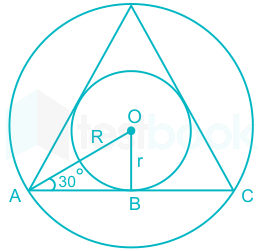
ΔOAB,\(Sin 30 =\frac{r}{R}\)
R = 2r
The ratio of the area of the inscribed circle to the area of the circumscribed circle
\(=\frac{\pi r^2}{\pi R^2}\)
\(=\frac{\pi r^2}{\pi (2r)^2}\)
\(=\frac{1}{4}\)
Let p, q, r denotes the statements ''It is raining'', ''It is cold'', and ''It is pleasant'', respectively. Then the statement ''It is not raining, and it is pleasant, and it is not pleasant only if it is raining and it is cold'' it represented by
- (¬ p ∧ r) ∧ (¬ r → (p ∧ q))
- (¬ p ∧ r) ∧ ((p ∧ q) → ¬ r)
- (¬ p ∧ r) ∨ ((p ∧ q) → ¬ r)
- (¬ p ∧ r) ∨ (r → (p ∧ q))
Answer (Detailed Solution Below)
Option 1 : (¬ p ∧ r) ∧ (¬ r → (p ∧ q))
Concept:
And operator - ʌ
Only if meaning: q only if means that p is a necessary condition for q , denoted as : q → p
Explanation:
p = it is raining
q = it is cold
r = it is pleasant
¬ p = it is not raining
Now, "' It is not raining, and it is pleasant" = ¬ p ʌ r
"it is not pleasant only if it is raining and it is cold'' denoted as = ¬ r → (p ʌ q)
So, the overall expression for ''It is not raining and it is pleasant, and it is not pleasant only if it is raining and it is cold'' will be:
( ¬ p ʌ r ) ʌ ( ¬ r → (p ʌ q ) )
Option 1) is true.
Which of the following pairs of propositions are not logically equivalent ?
- ((p → r) ∧ (q → r)) and ((p ∨ q) → r)
- p ↔ q and (¬ p ↔ ¬ q)
- (p → q) ∧ (q → p) and p ↔ q
- ((p ∧ q) → r ) and ((p → r) ∧ (q → r))
Answer (Detailed Solution Below)
Option 4 : ((p ∧ q) → r ) and ((p → r) ∧ (q → r))
The correct answer is option 4.
 Key Points
Option A:((p → r) ∧ (q → r)) and ((p ∨ q) → r)
Both are equal and it gives the same truth table. Hence it is logically equivalent.
Option B: p ↔ q and (¬ p ↔ ¬ q)
(p → q)(q → p) and (¬ p → q)(¬ q →p)
(p+q̅)(q+p̅) and (p+q̅)(q+p̅)
Both are equal and it gives the same truth table. Hence it is logically equivalent.
Option C: (p → q) ∧ (q → p) and p ↔ q
Both tables give equal values. Hence it is logically equivalent.
Option D:((p ∧ q) → r ) and ((p → r) ∧ (q → r))
| P | Q | R | ¬P | ¬Q | P⇒R | Q⇒R | (P⇒R)∧(Q⇒R) | P∧Q | P∧Q⇒R |
| T | T | T | F | F | T | T | T | T | T |
| T | T | F | F | F | F | F | F | T | F |
| T | F | T | F | T | T | T | T | F | T |
| T | F | F | F | T | F | T | F | F | T |
| F | T | T | T | F | T | T | T | F | T |
| F | T | F | T | F | T | F | F | F | T |
| F | F | T | T | T | T | T | T | F | T |
| F | F | F | T | T | T | T | T | F | T |
The above truth table is not equivalent. Hence the above statement isTrue, Logically not equivalent.
∴ Hence the correct answer is ((p ∧ q) → r ) and ((p → r) ∧ (q → r)).
Consider the following two statements.
S1: If a candidate is known to be corrupt, then he will not be elected
S2: If a candidate is kind, he will be elected
Which one of the following statements follows from S1 and S2 as per sound inference rules of logic?- If a person is known to be corrupt, he is kind
- If a person is not known to be corrupt, he is not kind
- If a person is kind, he is not known to be corrupt
- If a person is not kind, he is not known to be corrupt
Answer (Detailed Solution Below)
Option 3 : If a person is kind, he is not known to be corrupt
Concept:
Hypothetical syllogism,
If p → q and q → r then p → r
Formula:
p → q ≡ ¬ q → ¬ p ≡ ¬ p ∨ q
Explanation:
C(x): x is known to be corrupt
E(x): x will be elected
K(x): x is kind
Statement S1 can be written as:
\({\rm{S}}1 \equiv {\rm{C}}\left( {\rm{x}} \right){\rm{\;}} \to \neg {\rm{E}}\left( {\rm{x}} \right)\)
S2 can be written as:
\({\rm{S}}2 \equiv {\rm{K}}\left( {\rm{x}} \right) \to {\rm{E}}\left( {\rm{x}} \right) \equiv \neg {\rm{E}}\left( {\rm{x}} \right) \to \neg {\rm{K}}\left( {\rm{x}} \right)\)
By using hypothetical syllogism,
From S1 and S2, the conclusion is
\({\rm{C}}\left( {\rm{x}} \right) \to {\rm{\;}}\neg {\rm{\;K}}\left( {\rm{x}} \right) \equiv {\rm{K}}\left( {\rm{x}} \right) \to \neg {\rm{C\;}}\left( {\rm{x}} \right)\)
If a person is kind, then he is not known to be corrupt.
Which of the following equation represents a function?
- |x| + |y| = 2
- |x + y| = 2
- |y| = x2 + sin x
- |x|2 - x
Answer (Detailed Solution Below)
Option 4 : |x|2 - x
Concept:
Function: An equation is said to be a function if, for each possible input value, there is exactly one output value.
Explanation:
Here the equation can be f(x) or f(y), so the equation which will satisfy the above criteria can be called a function.
Equation 1) |x| + |y| = 2
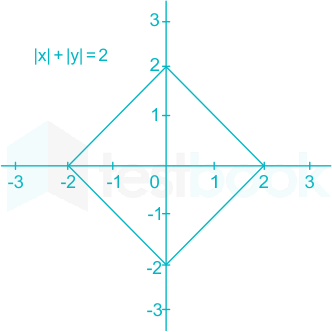
- This equation cannot be a function of x or y since modulus will always give two values for x or y.
Equation 2) |x + y| = 2
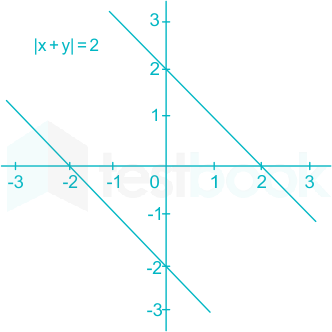
- This equation cannot be a function since opening the modulus bracket gives two values to both x and y.
Equation 3) |y| = x2 + sin x
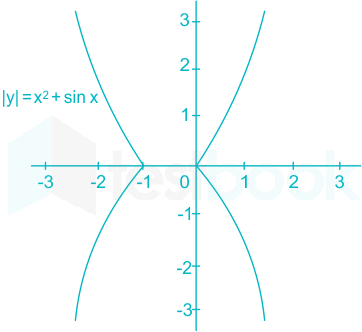
- This equation cannot be a function since due to |y| the negative part of RHS will reflect from the Y-axis and finally, it will give multiple y for the same x
Equation 4) |x|2 - x
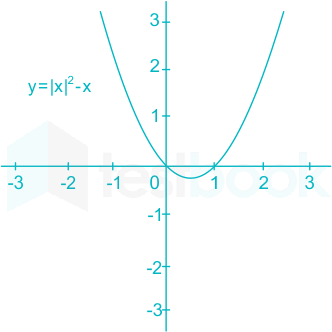
- Assuming the equation as y = |x|2 - x, it becomes a function of x.
- For every x, there is only one value of y.
Hence, the required equation which can be called a function is |x|2 - x.
Which one of the following Boolean expressions is NOT a tautology?
- \(((a→b)∧(b→c))→(a→c)\)
- \((a↔c)→(∼b→(a∧c))\)
- \((a∧b∧c)→(c∨a)\)
- \(a→(b→a)\)
Answer (Detailed Solution Below)
Option 2 : \((a↔c)→(∼b→(a∧c))\)
(i) Tautology: Implication is transitive.
(ii). Contingency: Truth value of this formula depends upon the values of a, b and c.
(iii). Tautology: Consequent clearly follows from antecedent.
(iv). Tautology: a->b is false only when a is true and b is false.
Consider the following expressions:
(i) false
(ii) Q
(iii) true
(iv) P ∨ Q
(v) ¬ Q ∨ P
The number of expressions given above that are logically implied by P ∧ (P ⇒ Q) is ________
Answer (Detailed Solution Below) 4
Concept:
P ⇒ Q means P̅ ∨ Q
Explanation:
P ∧ (P ⇒ Q) = P ∧ (P̅ ∨ Q) = P ∧ Q
Let us consider P.Q as A.
We have to find which of the given expression is implied by A, that is, (A => )
Construct the truth table for each option separately
Let A ≡ P ∧ (P ⇒ Q)
| P | Q | P ⇒ Q | A |
| True | True | True | True |
| True | False | False | False |
| False | True | True | False |
| False | False | True | False |
Consider all options one by one:
(i) False
| P | Q | A | A ⇒ False |
| True | True | True | False |
| True | False | False | True |
| False | True | False | True |
| False | False | False | True |
Here, all are not true. So, this option is incorrect.
(ii) Q
| P | Q | A | A ⇒ Q |
| True | True | True | True |
| True | False | False | True |
| False | True | False | True |
| False | False | False | True |
This option is implied by P ∧ (P ⇒ Q).
iii) True
| P | Q | A | A ⇒ True |
| True | True | True | True |
| True | False | False | True |
| False | True | False | True |
| False | False | False | True |
iv) P ∨ Q
| P | Q | A | A ⇒ P ∨ Q |
| True | True | True | True |
| True | False | False | True |
| False | True | False | True |
| False | False | False | True |
This is a tautology. So, option is correct.
v) –Q ∨ P
| P | Q | A ≡ P ∧ (P ⇒ Q) | A ⇒ –Q ∨ P |
| True | True | True | True |
| True | False | False | True |
| False | True | False | True |
| False | False | False | True |
This is also a tautology.
So, total 4 are implied by the given expression.
Which one of the following well - formed formulae is a tautology?
- ∀𝑥 ∃𝑦 (𝑥, ) ↔ ∃𝑦 ∀𝑥 𝑅(𝑥, 𝑦)
- (∀𝑥 [∃𝑦 (𝑥, ) → 𝑆(𝑥, 𝑦)]) → ∀𝑥∃𝑦 𝑆(𝑥, 𝑦)
- [∀𝑥 ∃𝑦 (𝑃(𝑥, 𝑦) → 𝑅(𝑥, 𝑦)]↔[∀𝑥 ∃𝑦 (¬ 𝑃(𝑥, 𝑦) ∨ 𝑅(𝑥, 𝑦)]
- ∀𝑥 ∀𝑦 (𝑥, ) → ∀𝑥 ∀𝑦 𝑃(𝑦, 𝑥)
Answer (Detailed Solution Below)
Option 3 : [∀𝑥 ∃𝑦 (𝑃(𝑥, 𝑦) → 𝑅(𝑥, 𝑦)]↔[∀𝑥 ∃𝑦 (¬ 𝑃(𝑥, 𝑦) ∨ 𝑅(𝑥, 𝑦)]
Option 1: ∀ x ∃y R (x, y) ↔ ∃y ∀ x R(x, y)
∀ x ∃y R (x, y) is not equivalent to ∃y ∀ x R(x, y).
Let R (x, y) represent x > x for the set of numbers as the universe
Example:
∀ x ∃y R (x, y) means for every number x, there exist a number y that is less than x which is true.
While ∃y ∀ x R(x, y) means there is a number that is less than every number. Which is false
Option 2: (∀ x (∃y R(x, y) → S (x, y)]) → ∀ x ∃y S(x, y)
This option is not a tautology. It is a false expression because two predicates can't be equivalent to single predicate on right side.
Option 4: ∀ x ∀ y P (x, y) → ∀ x ∀ y P (y, x)
Consider P (x, y) as x < y
then ∀ x ∀ y P (x, y) represents for every number x, all y are greater than x.
∀ x ∀ y P (y, x), it means for every number y, there is every x which is greater than y.
These two statements are not equivalent at the same time. So, it is not a tautology.
Option 3:
[∀x ∃y (P(x, y) → R(x, y)] ↔ [∀ x ∃y (¬ P(x, y) ∨ R (x, y)]
As, we know that P → R = ¬ P + R
Here, it is the same statement as that of implication, so it is a tautology.
If\(\sqrt {1 + \frac{x}{{225}}} = \frac{{17}}{{15}}\) , then the value of x is ______.
- 25
- \(3\sqrt {15} \)
- \(4\sqrt {17} \)
- 64
Answer (Detailed Solution Below)
Option 4 : 64
Explanation:
We have,
\(\sqrt {1 + \frac{x}{{225}}} = \frac{{17}}{{15}}\)
Squaring both side we get,
\({1 + \frac{x}{{225}}} = \frac{{289}}{{225}}\)
\({\frac{x}{{225}}} = \frac{{289~-~225}}{{225}}\)
\({\frac{x}{{225}}} = \frac{{64}}{{225}}\)
x = 64
Hence, the required value of x = 64.
The value of\({4^{2{{\log }_9}3}}\) is
- 4
- 2
- 3
- 1
Answer (Detailed Solution Below)
Option 1 : 4
Concept:
logxn yz = (1/n) × logx yz, also
loga a = 1
Calculation:
Here we can rewrite the above term as\({4^{2{{\log }_9}3}}\)
\({4^{2{{\log }_9}3}}\) =\({4^{2{{\log }_{{3^2}}}3}}\)
\({4^{2{{\log }_9}3}}\) =\({4^{\left( {2\; \times \;\frac{1}{2}\; \times \;{{\log }_3}3} \right)}}\)
\({4^{2{{\log }_9}3}}\) = 4
Hence the value of\({4^{2{{\log }_9}3}}\) is 4.
Consider the first-order logic sentence F: ∀x (∃ y R(x, y)). Assuming no-empty logical domains, which of the sentence below are implied by F?
- ∃y (∃x R(x, y))
- ∃y (∀x R(x, y))
- ∀y (∃x R(x, y))
- ¬ ∃x (∀y ¬ R(x, y))
- IV only
- I and IV only
- II only
- II and III only
Answer (Detailed Solution Below)
Option 2 : I and IV only
Concept:
| True | False | |
| ∀ x | All | Atleast one false |
| ∃ x | Atleast one true | For all x, if P(x) is false, if we are taking predicate as P(x) |
One of the methods for this question is by considering x and y as the domains by using some statements.
Let us suppose x is for a girl and y is for a boy.
Given F is ∀x(∃ y R(x, y)) , in case of English language this means,
F: All girls like some boys
Now, check all the option one by one.
- ∃y (∃x R(x, y)) means some boys are liked by some girls.
From this statement it is clear that it is the subset of given statement. TRUE
- ∃y (∀x R(x, y)) means some boys are liked by all the girls. FALSE
- ∀y (∃x R(x, y)) means all boys are liked by some girls which is opposite of given statement. So, this is FALSE.
- ¬ ∃x (∀y ¬ R(x, y)) means for all girls like some boys. So, this is equivalent to given statement. TRUE
Alternate:
¬ ∃x (∀y ¬ R(x, y)) ≡ ∀x(¬ ∀y( ¬ R(x, y))) ≡ ∀x(∃x R(x, y))
∀x (∃ y R(x, y)) → ∃ x (∃ y R(x, y))
If T(x) denotes is a trigonometric function, P(x) denotes x is a periodic function and C(x) denotes x is a continuous function then the statement "It is not the case that some trigonometric functions are not periodic" can be logically represented as
- ¬ ∃x[T(x) ∧ ¬ P(x)]
- ¬ ∃x[T(x) ∨ ¬ P(x)]
- ¬ ∃x[¬T(x) ∧ ¬ P(x)]
- ¬ ∃x[T(x) ∧ P(x)]
Answer (Detailed Solution Below)
Option 1 : ¬ ∃x[T(x) ∧ ¬ P(x)]
Statement: "It is not the case that some trigonometric functions are not periodic"
"some trigonometric functions are not periodic" means
There exist some trigonometric functions which are also not periodic.
∃x [T(x) ∧ ¬ P(x)]
The negation of it.
"It is not the case that some trigonometric functions are not periodic"
¬ ∃x[T(x) ∧ ¬ P(x)]
If\(x = 7 - 4\sqrt 3 \) then the value of\(x + \frac{1}{x}\) is
- \(3\sqrt 3 \)
- \(8\sqrt 3 \)
- 14
- 14 +\(8\sqrt 3 \)
Answer (Detailed Solution Below)
Option 3 : 14
Explanation:
We have,\(x = 7 - 4\sqrt 3 \)
Placing this value of x in,\(x + \frac{1}{x}\) we get
\(x + \frac{1}{x}\) =\(7 - 4\sqrt 3 + \frac{1}{{7 - 4\sqrt 3 }}\)
Rationalizing the denominator of 2nd term
\(x + \frac{1}{x}\) =\(7 - 4\sqrt 3 \;+\;7 + 4\sqrt 3 \)
\(x + \frac{1}{x}\) = 14
Hence, the value of\(x + \frac{1}{x}\) for the given value of x is 14.
Let p, q, and r be propositions and the expression (p → q) → r be a contradiction. Then the expression (r → p) → q is
- A tautology
- A contradiction.
- Always TRUE when p is FALSE
- Always TRUE when q is TRUE
Answer (Detailed Solution Below)
Option 4 : Always TRUE when q is TRUE
(p → q) → r is a contradiction which is possible only when r is false and (p → q) is true.
Now, from here we can clearly say that option 4 is correct as (r → p) → q means ¬ (r → p) ∨ q.
Since r is false, (r → p) is true and ¬ (r → p) becomes false.
So, it becomes (false ∨ q). Now it totally depends on q. Whenever q is true, this value will always be true.
Alternate Method:
Let X ≡ p → q, Y ≡ (p → q) → r ≡ X → r,
Z ≡ r → p and W ≡ (r → p) → q ≡ Z → p
Using Truth table
| p | q | r | X | Y | Z | W |
| 0 | 0 | 0 | 1 | 0 | 1 | 0 |
| 0 | 0 | 1 | 1 | 1 | 0 | 1 |
| 0 | 1 | 0 | 1 | 0 | 1 | 1 |
| 0 | 1 | 1 | 1 | 1 | 0 | 1 |
| 1 | 0 | 0 | 0 | 1 | 1 | 0 |
| 1 | 0 | 1 | 0 | 1 | 1 | 0 |
| 1 | 1 | 0 | 1 | 0 | 1 | 1 |
| 1 | 1 | 1 | 1 | 1 | 1 | 1 |
So, from truth table also, it is clear that (r → p) → q is always true when q is true, and Y is false.
Which one of the following options is CORRECT given three positive integers x, y and z, and a predicate
P(x)= -(x = 1) ∧ ∀ y(∃z(x=y*z) ⇒ (y = x) ∨ (y = 1))
- P(x) being true means that x is a prime number
- P(x) being true means that x is a number other than 1
- P(x) is always true irrespective of the value of x
- P(x) being true means that x has exactly two factors other than 1 and x
Answer (Detailed Solution Below)
Option 1 : P(x) being true means that x is a prime number
The correct answer is option 1.
Key Points
| Precedence of logical operators | |
| operators | precedence |
| ¬ NOT | 1 |
| ∧ AND | 2 |
| ∨ OR | 3 |
| ⇒ conditional | 4 |
| ⇔ bi-conditional | 5 |
The given predicate is,
P(x)= -(x = 1) ∧ ∀ y(∃z(x=y*z) ⇒ (y = x) ∨ (y = 1))
If x is a prime number then (x ≠1 and the only divisors of x are x and 1)
∴P(x) is true means x is a prime number.
Hence the correct answer is P(x) being true means that x is a prime number.
Consider the statement below.
A person who is radical (R) is electable (E) if he/she is conservative (C), but otherwise is not electable.
Few probable logical assertions of the above sentence are given below.
(A)\(\left( {R \wedge E} \right) \Longleftrightarrow C\)
(B)\(R\; \Rightarrow \left( {E \Leftrightarrow C} \right)\)
(C)\(R \Rightarrow \left( {\left( {C \Rightarrow E} \right)V\;\neg \;E} \right)\)
(D)\(\left( {\neg \;R \vee \neg \;E \vee C} \right) \wedge \left( {\neg \;R \vee \neg \;C \vee E} \right)\;\;\)
Which of the above logical assertions are true?
Choose the correct answer from the options given below:
- (B) only
- (C) only
- (A) and (C) only
- (B) and (D) only
Answer (Detailed Solution Below)
Option 4 : (B) and (D) only
The correct answer is option 4
Explanation:
1) (R ∧ E) ⟺ C says that all (and only) conservatives are radical and electable. So, this assertion is not true.
2) R ⇒ (E ⇔ C) says that same as the given assertion. This is a correct assertion.
3) R ⇒ ((C ⇒ E) V ¬E) = ¬ R ∨ ( ¬ C ∨ E ∨ ¬ E ) which is true for all interpretations. This is not a correct assertion.
4) ( ¬ R V ¬ E V C) ∧ (¬ R V ¬ C V E) = (¬ RV( E⇒ C)) ∧ (¬ R V (C ⇒ E)) = R ⇒ (E ⇔ C) which is equivalent to assertion B. This is also true.
\(\sqrt[3]{{\sqrt {0.000729} }} =\)
- \(\sqrt 3\)
- 0.03
- 0.3
- 0.00314
Answer (Detailed Solution Below)
Option 3 : 0.3
Explanation:
Let's assume the required value of\(\sqrt[3]{{\sqrt {0.000729} }}\) is x so,
x =\(\sqrt[3]{{\sqrt {0.000729} }}\)
On factorizing the most inner term 0.000729 in two equal terms, we get
x = \(\sqrt[3]{{\sqrt {0.027\times0.027} }}\)
x =\(\sqrt[3]{{\sqrt {{0.027}^{2}} }}\)
x =\(\sqrt[3]{0.027}\)
On factorizing the most inner term 0.027 in three equal terms, we get
x =\(\sqrt[3]{0.3\times0.3\times0.3}\)
x =\(\sqrt[3]{{0.3}^3}\)
x = 0.3
Hence, the required value of\(\sqrt[3]{{\sqrt {0.000729} }}\) is 0.3.
Mathematical Logic Questions With Answers Pdf
Source: https://testbook.com/objective-questions/mcq-on-mathematical-logic--5eea6a0a39140f30f369dcd9
Posted by: cannonittleave.blogspot.com
0 Response to "Mathematical Logic Questions With Answers Pdf"
Post a Comment